
Case No. 002 · FORECAST · Now Hearing
Commonwealth v. Lindsay Clancy
The Duxbury case. An AI jury forecasts Guilty, 8 to 4. Read the record and cast your human verdict before the real jury returns.
The Deliberation Room · 4 arguments ↓ Share this case
No verdict: forecast void and held open
Mistrial declared September 4, 2026. After seven days of deliberation the Plymouth County jury told the court, in the words of its final note, that it was unable to come to a unanimous decision and would not be able to. Reporting on the jury notes put the split at eleven to one in favor of a finding of not criminally responsible. Judge William Sullivan declined to remove the holdout juror, a single justice of the Supreme Judicial Court denied the defense's emergency petition, and the judge discharged the jury.
Under the rule published on this page on August 27, before the jury returned, a mistrial is void and held open. Nobody scored right and nobody scored wrong. The sealed forecast stays sealed against any later disposition, under the same rule and the same digest, and resolves only if every count reaches a final disposition in the same direction.
The Commonwealth has not said whether it will retry the case. The court set September 29, 2026 for a hearing on next steps. The defendant remains held at a state psychiatric hospital. Voting here stays open.
The Docket Log100 entries · what has happened since this case opened
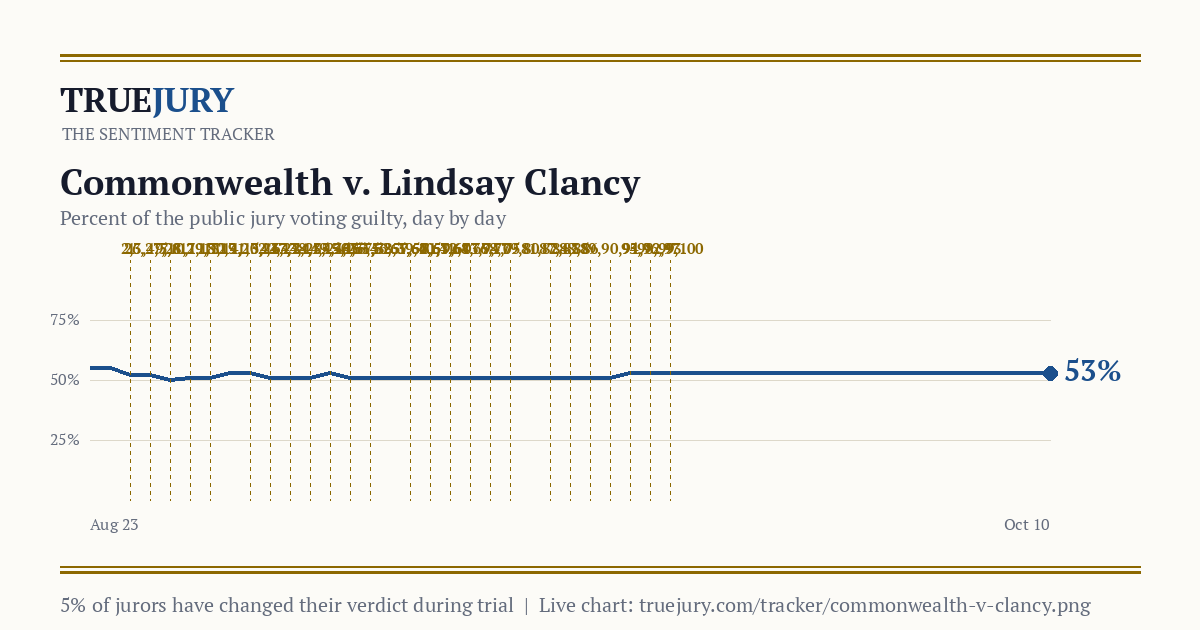
Developments in the real proceeding, logged as they are reported and linked to their source. Entries describe what happened; nothing here is a judgment of the case. Numbered ticks on the Sentiment Tracker point back to this log.
- Oct 5, 2026The judge denied the defense motion to find the defendant not guilty following the mistrial. (Michigan Lawyers Weekly)
- Oct 5, 2026The defense filed a motion to dismiss charges citing double jeopardy. (ABC News - Breaking News, Latest News and Videos)
- Oct 3, 2026An investigator testified that the defendant searched "can you treat a sociopath" prior to killing her three children. (6abc Philadelphia)
- Oct 2, 2026The judge denied the defendant's motion for acquittal in the murder trial. (foxnews.com)
- Oct 1, 2026The judge denied the defendant's motion for a required finding of not guilty on the murder charges. (WCVB)
- Oct 1, 2026A chaplain testified on October 1 that the defendant stated she was glad her children were safe after killing them. (6abc Philadelphia)
Earlier entries (94)
- Sep 30, 2026The holdout juror gave a recorded statement to Fox News on September 30 discussing his position in the case. (facebook.com)
- Sep 30, 2026The defendant's ex-husband testified during the retrial on September 30. (ABC News - Breaking News, Latest News and Videos)
- Sep 29, 2026Psychiatrists testified that the defendant did not show signs of psychosis. (abcnews.com)
- Sep 29, 2026A nurse practitioner testified on September 29 about messages from the defendant. (ABC News - Breaking News, Latest News and Videos)
- Sep 29, 2026The defense argued at a status hearing that prosecutors did not prove the defendant killed her three children. (WCVB)
- Sep 29, 2026Prosecutors requested a gag order to prevent what they characterized as a carnival atmosphere following Kevin Reddington's comments. (New York Post)
- Sep 29, 2026The defense filed motions to dismiss the case following the mistrial declaration. (WFSB)
- Sep 29, 2026The defense presented testimony that the defendant had no memory of killing her three children. (The Boston Globe)
- Sep 29, 2026Kevin Reddington was appointed to represent the defendant in the retrial. (Western Mass News)
- Sep 28, 2026The holdout juror's attorney made statements criticizing the defense on September 28. (Fox News)
- Sep 28, 2026A status hearing was scheduled for Tuesday in the case. (WWLP)
- Sep 27, 2026Clancy appeared in court for the first time since the mistrial declaration. (CNN)
- Sep 27, 2026Lindsay Clancy entered a not guilty plea to murder charges in connection with the death of her 2-year-old child. (National News Desk)
- Sep 26, 2026Clancy's attorney Kevin Reddington requested a presidential pardon after the mistrial declaration. (ABC News - Breaking News, Latest News and Videos)
- Sep 25, 2026The judge declared a mistrial in the case. (ABC30 Fresno)
- Sep 24, 2026A psychiatrist testified for the prosecution after the defense rested its case, calling into question Clancy's mental state. (ABC News - Breaking News, Latest News and Videos)
- Sep 24, 2026The holdout juror's attorney issued a statement characterizing the defendant as a "demon" and defending his client's position in the case. (New York Post)
- Sep 23, 2026The holdout juror alleged that other jurors used phones during murder trial deliberations. (Yahoo)
- Sep 23, 2026The judge indefinitely impounded jury questionnaires in the case on September 23. (ABC News - Breaking News, Latest News and Videos)
- Sep 23, 2026The judge issued a ruling citing a "real and present" risk of harm to jurors in the case. (facebook.com)
- Sep 23, 2026The judge extended the impoundment order on the juror list and questionnaires in the case. (NBC Boston)
- Sep 22, 2026The defense filed a motion to dismiss the case on double jeopardy grounds. (Boston.com)
- Sep 22, 2026Defense lawyers filed a motion asking the judge to investigate the holdout juror in the deadlocked case. (Scripps News)
- Sep 22, 2026The defense attorney requested that the judge investigate the lone juror who voted to convict on September 22. (AP News)
- Sep 22, 2026The defense filed a motion requesting that the judge investigate the holdout juror's conduct. (CNN)
- Sep 22, 2026The defense filed a motion to dismiss charges citing double jeopardy protections. (Good Morning America)
- Sep 21, 2026Lindsay Clancy moved to dismiss the murder charges on double jeopardy grounds in response to the prosecution's retrial plans. (CT Insider)
- Sep 21, 2026The defense filed a motion asking the judge to dismiss the murder case over the handling of the deadlocked jury. (MassLive.com)
- Sep 21, 2026The defense moved for an investigation into the holdout juror following the mistrial declaration. (The New York Times)
- Sep 21, 2026The defense filed a motion requesting judicial investigation into the holdout juror's phone records. (New York Post)
- Sep 21, 2026The defense filed a motion seeking information about the holdout juror after his criminal history was revealed. (MassLive.com)
- Sep 21, 2026The defense filed a motion to dismiss under double jeopardy grounds following the mistrial, focusing on the holdout juror's conduct. (Fox News)
- Sep 21, 2026The defense filed a motion requesting the judge investigate the holdout juror and examine his phone records. (nypost.com)
- Sep 21, 2026The defense requested that the judge investigate the holdout juror and dismiss the criminal case. (CBS News)
- Sep 21, 2026The defense filed a motion citing double jeopardy to dismiss charges following the mistrial. (ABC News - Breaking News, Latest News and Videos)
- Sep 21, 2026The defense filed a motion requesting the judge investigate the holdout juror following the mistrial declaration. (The New York Times)
- Sep 21, 2026A mistrial was declared in the case against Lindsay Clancy. (CBC)
- Sep 21, 2026Patrick Clancy gave an interview reflecting on the deaths of his children and his views regarding his ex-wife. (CNN)
- Sep 20, 2026The holdout juror's attorney warned of public attacks against his client and the juror made a new public statement. (Fox News)
- Sep 20, 2026Patrick Clancy testified in the trial of Lindsay Clancy, who is accused of killing her three children. (ABC News - Breaking News, Latest News and Videos)
- Sep 20, 2026Patrick Clancy testified at trial regarding the case against Lindsay Clancy. (ABC News - Breaking News, Latest News and Videos)
- Sep 19, 2026Patrick Clancy stated in an interview that he believed he did the best he could at the time. (CBS News)
- Sep 18, 2026The holdout juror stated in an interview that Lindsay Clancy knew exactly what she was doing. (USA Today)
- Sep 18, 2026The holdout juror stated in an interview that he did not have any doubts during deliberations. (ABC News - Breaking News, Latest News and Videos)
- Sep 18, 2026The holdout juror's attorney stated the juror would not be giving interviews. (NBC News)
- Sep 18, 2026A juror told interviewers that no evidence presented showed anything other than a loving, wonderful person. (weau.com)
- Sep 18, 2026The holdout juror stated in an interview that he had no doubts during deliberations in the murder case. (ABC30 Fresno)
- Sep 18, 2026An attorney stated he represents the holdout juror and characterized him as an American Hero. (Fox News)
- Sep 18, 2026A juror who blocked the verdict disputed fellow jurors' claims in an interview reported on Fox News. (Fox News)
- Sep 17, 2026A juror gave an interview to NBC 10 News describing the deliberations and discussing a potential retrial. (WJAR)
- Sep 16, 2026A high-profile attorney joined Lindsay Clancy's legal team for the double jeopardy challenge following the mistrial. (Boston 25 News)
- Sep 16, 2026Lindsay Clancy hired a prominent attorney who stated he plans to file a motion to dismiss the case on double jeopardy grounds. (The Boston Globe)
- Sep 15, 2026The judge extended the order sealing jurors' names indefinitely, citing risk of immediate and irreparable injury. (CBS News)
- Sep 15, 2026The holdout juror's brother disclosed in an interview details about the juror's reasoning for voting guilty. (New York Post)
- Sep 15, 2026Judge sealed the jurors' names indefinitely over safety concerns. (CT Insider)
- Sep 13, 2026A psychiatrist testified about Clancy's mental state after the defense rested. (ABC News - Breaking News, Latest News and Videos)
- Sep 13, 2026Court records showed the holdout juror in the Lindsay Clancy trial faced a domestic violence allegation that was later dismissed. (CBS News)
- Sep 13, 2026Governor Ron DeSantis offered asylum to the holdout juror in the case. (People.com)
- Sep 12, 2026A juror stated the holdout juror said he had reasonable doubt but would not vote to acquit. (8newsnow.com)
- Sep 12, 2026Governor DeSantis stated that Florida would provide asylum to the holdout juror in the case. (The Hill)
- Sep 11, 2026Jurors reported receiving death threats after the mistrial was declared. (The Times)
- Sep 11, 2026The defense attorney filed a motion to bar retrial of Lindsay Clancy. (FOX 13 Tampa Bay)
- Sep 11, 2026A juror stated in an interview that the holdout juror was fixated on the amount of blood at the crime scene. (People.com)
- Sep 11, 2026The New York Post reported that the holdout juror in the Clancy case has a history of domestic violence allegations and an active restraining order. (New York Post)
- Sep 11, 2026A juror revealed in an interview that deliberations shifted from 10-2 to 11-1 as dissenters felt attacked. (People.com)
- Sep 10, 2026The defense attorney moved for a judgment of acquittal or dismissal based on evidence presented during trial. (The Guardian)
- Sep 10, 2026Jurors said nurses who testified helped them understand key medical evidence during the trial. (CT Insider)
- Sep 10, 2026A juror told another juror that the holdout juror mimicked strangling during deliberations. (ABC News - Breaking News, Latest News and Videos)
- Sep 10, 2026The defense filed a motion asking the judge to bar a second trial for Clancy on double jeopardy grounds. (AP News)
- Sep 10, 2026Clancy's lawyer filed a motion asking the judge to enter a judgment of acquittal following the mistrial. (The Guardian)
- Sep 10, 2026A juror alleged during deliberations that the lone holdout juror exhibited behavior described as disgusting. (The Boston Globe)
- Sep 9, 2026The defense attorney said he would ask for the case to be dismissed after speaking with jurors. (cbsnews.com)
- Sep 9, 2026The foreperson stated that the holdout juror had reasonable doubt but would not acquit. (newsnationnow.com)
- Sep 9, 2026Three jurors identified a fellow juror as the holdout blocking a verdict after the mistrial was declared. (Reuters)
- Sep 9, 2026The jury foreperson stated that a juror had reasonable doubt but would not agree to acquit. (The Guardian)
- Sep 8, 2026The jury foreperson said a juror admitted he had reasonable doubt during deliberations. (NBC News)
- Sep 8, 2026The defense attorney expressed willingness to work out a plea deal. (CNN)
- Sep 8, 2026Clancy's attorney Kevin Reddington requested a presidential pardon from Donald Trump following the mistrial. (ABC News - Breaking News, Latest News and Videos)
- Sep 8, 2026A juror stated that the holdout juror admitted during deliberations to having reasonable doubt. (CNN)
- Sep 8, 2026Three jurors gave interviews to NBC Boston describing the deliberations, the holdout juror, and their views of the prosecution and defense. (NBC Boston)
- Sep 8, 2026The defense attorney urged President Trump to consider a pardon for Lindsay Clancy following the mistrial. (The Guardian)
- Sep 6, 2026The court ordered the juror list kept confidential for fourteen days. (NewsNation)
- Sep 5, 2026Prosecutors announced they would not decide on September 5, 2026 whether to retry Lindsay Clancy. (NewsNation)
- Sep 4, 2026After the mistrial the court set September 29, 2026 for a hearing on next steps. The Plymouth County District Attorney said his office had not decided whether to retry the case. The defendant remains held at a state psychiatric hospital. (ABC News)
- Sep 4, 2026The judge denied the defense's last-minute appeal and formally declared a mistrial. (WGBH)
- Sep 4, 2026The judge gave the defense one hour to appeal before declaring a mistrial. (Reuters)
- Sep 4, 2026The judge declared a mistrial after determining the jury was hopelessly deadlocked on September 4, 2026. (NBC News)
- Sep 4, 2026The jury reported that deliberations were apparently stuck at eleven to one on September 4, 2026. (PBS)
- Sep 4, 2026The judge denied the defense's emergency appeal to the state Supreme Judicial Court and declared a mistrial in the Lindsay Clancy case. (wcvb.com)
- Sep 3, 2026The judge declined to remove the juror whose removal the defense had requested. (BBC)
- Sep 3, 2026The judge excused a juror after the defense attributed the deadlock to that juror's conduct. (The Hill)
- Sep 3, 2026A defense attorney requested the removal of a juror on September 3, 2026. (NBC 5 Chicago)
- Sep 3, 2026The jury resumed deliberations for a sixth day on September 3, 2026, after reporting deadlock twice. (Reuters)
- Sep 3, 2026The jury reported a second deadlock on September 3, 2026. (news4jax.com)
The Case Fileread the record, then vote
This case is a forecast. A real jury in Plymouth County, Massachusetts is about to decide it. Your verdict here is the public jury's assessment of the public record and a prediction of the outcome. It judges nothing and no one; the real courtroom does that. When the case goes to the real jury, the official forecast locks as of that moment; voting stays open until the verdict, and later votes are recorded as cast during deliberations.
On the evening of January 24, 2023, in Duxbury, Massachusetts, the three children of Lindsay Clancy, a 32-year-old labor and delivery nurse, were killed in the family's home: the eldest five years old, the middle child three, and the youngest an infant of eight months. The Commonwealth alleges, and the defense does not dispute, that Ms. Clancy strangled them while her husband was out of the house on errands. When he returned, he found the children. Ms. Clancy then attempted to take her own life by jumping from an upper window of the home. She survived with a spinal injury that left her unable to walk, and trial coverage reports she has been held for psychiatric care since.
The Commonwealth charged her with three counts of first-degree murder. What happened in the house is not in dispute. The trial is about one question: was she criminally responsible?
Under Massachusetts law, a defendant is not criminally responsible if, because of a mental disease or defect, she lacked the substantial capacity to appreciate the wrongfulness of her conduct or to conform her conduct to the law. Once the defense raises the issue, the burden falls on the Commonwealth to prove criminal responsibility beyond a reasonable doubt.
The defense case. Ms. Clancy's attorney contends she was in the grip of postpartum psychosis, a rare and severe psychiatric emergency that can follow childbirth. In the months before that night she sought psychiatric care repeatedly, reported intrusive and violent thoughts, and cycled through a series of psychiatric medications; the defense argues the treatment itself worsened her condition. Defense witnesses, including people who knew her and mental health experts, testified that her mind had broken. Her husband, Patrick Clancy, said publicly in the weeks after the killings that he had forgiven her, and asked others to do the same.
The Commonwealth's case. Prosecutors argue the killings were deliberate and planned. They point to the timing: the errands, the Commonwealth argues, were constructed to create a known window alone with the children, while the defense describes the same request as an ordinary evening errand for dinner and a pharmacy item. The Commonwealth presented its own psychiatric expert, who testified that whatever her suffering, she retained the substantial capacity to know that what she was doing was wrong, and it pointed the jury to the sequence of that evening itself as evidence of awareness and intention. Deliberate planning, the Commonwealth argues, is the mark of a mind that understood its own conduct.
The question before you is the question before that jury: has the Commonwealth proven, beyond a reasonable doubt, that Lindsay Clancy was criminally responsible? Your answer is an assessment of the public record and a forecast. The Plymouth County jury decides the case.
For the Plaintiff
The Commonwealth does not ask the jury to deny that Lindsay Clancy suffered. It asks the jury to look at what she did, step by step, on the night of January 24. She chose a window of time. The errands that emptied the house, the Commonwealth argues, were hers to arrange, and she arranged them. She acted within that window, completely, on all three children. Then she attempted to end her own life, which the Commonwealth submits she understood as the consequence of an act she knew to be profoundly wrong.
Planning is the signature of a functioning mind. A person who lacks the capacity to appreciate wrongfulness does not clear the room first. The law does not excuse a crime because the person who committed it was in pain; it excuses a crime only when disease severed the mind from the act. The evidence of orchestration, the Commonwealth argues, proves that connection was intact, and its own expert told the jury she retained the capacity to know right from wrong. Three children are dead, and the person who killed them understood what she was doing. That is criminal responsibility, proven beyond a reasonable doubt.
For the Defense
Nobody disputes what happened in that house, and that is precisely the point. Lindsay Clancy was a labor and delivery nurse who spent her working life bringing children into the world, a mother described by those who knew her as devoted to hers. The Commonwealth has offered no motive, and no history of anger or cruelty, because this was never a crime of will. It was a catastrophe of disease.
In the months before that night, she told clinicians about violent intrusive thoughts. She asked for help, again and again. She was medicated, re-medicated, and over-medicated, and the defense's experts testified her condition deepened into psychosis while the prescriptions changed around her. Postpartum psychosis is rare, real, and recognized by medicine; delusion can wear the appearance of method, which is why the appearance of planning proves nothing about a diseased mind. Her husband, who lost more than anyone, publicly forgave her within weeks. The defense asks the jury to weigh what that forgiveness, from the person closest to the whole of it, suggests about who she was and what happened to her mind. The Commonwealth cannot prove sanity beyond a reasonable doubt, and the law therefore requires the verdict: not guilty by reason of lack of criminal responsibility.
The AI Jury Forecastsimulation, never counted
Simulated Panel · Clearly Labeled · Never Counted in the Human Tally
Before human voting opened, twelve simulated jurors deliberated this record. The panel models a range of American demographic profiles and heard only the file above. This is a forecast of a pending case, not a judgment of it.
The AI jury's verdict: GUILTY, 8 to 4.
The simulated majority followed the Commonwealth's logic: the errand timing read to them as orchestration, and orchestration as capacity. The simulated minority found the medical record decisive: months of documented pleas for help, escalating medication, and a disease known to produce exactly this catastrophe, concluding the Commonwealth could not carry its burden beyond a reasonable doubt. Insanity defenses rarely persuade juries, and the panel reflected that. Beat the panel or prove it right; then watch what the real jury does.
How This Forecast Resolvesthe scoring rule, fixed in advance
Case No. 002, Commonwealth v. Lindsay Clancy. Status: forecast, open. This matter is pending before a real court. Nothing on this page is a judgment of this house. What follows is a forecast, a record of what our jurors expect a Plymouth County jury to do, and it will be scored against that jury's return.
What the trial jury was actually asked. The defendant stands trial on three counts of murder in the first degree, one count for each child. She was originally indicted on nine counts, three each of murder, strangulation, and assault and battery with a dangerous weapon. Prosecutors dropped the strangulation and assault counts before trial as redundant, on the reasoning that the strangulation was subsumed by the murder counts. Three counts went to the jury, and nothing else.
The trial judge instructed the jury to consider each child separately, with five possible returns available on each count:
- Not guilty
- Not guilty by reason of lack of criminal responsibility
- Guilty of murder in the first degree
- Guilty of murder in the second degree
- Guilty of manslaughter
Murder in the first degree requires deliberate premeditation, or extreme atrocity or cruelty. The jury retired at 12:35 p.m. Eastern on Thursday, August 27, 2026.
What our ballot asked. Two options were put to our jurors: Guilty and Not Guilty: Insanity. The second is plain language shorthand for the Massachusetts standard of lack of criminal responsibility. Our ballot named no degree, named no count, and did not ask anyone to consider the three children separately. It asked one question about one defendant. That is the question we will score, and it is the only question we will score.
How this forecast resolves. Each of the three counts is read as returning one of three states.
- Responsible: guilty of murder in the first degree, guilty of murder in the second degree, or guilty of manslaughter. All three are convictions.
- Not responsible: not guilty by reason of lack of criminal responsibility.
- Outside the ballot: straight not guilty, or no verdict returned on that count.
The forecast resolves only where all three counts come back in the same state, and only where that state appears on our ballot. Three counts in the responsible state resolve the forecast for Guilty. Three counts in the not responsible state resolve it for Not Guilty: Insanity. Anything else is recorded as void: no juror is scored correct, no juror is scored incorrect, and the case is published in full with an explanation of why it could not be scored.
In plain terms: if all three children receive the same answer to the question of responsibility, we score it. If they do not, we report it and score nothing.
Worked examples, so a reader can apply this without us.
- First degree on all three counts: resolves for Guilty.
- Lack of criminal responsibility on all three counts: resolves for Not Guilty: Insanity.
- Manslaughter on all three counts: resolves for Guilty, because manslaughter is a conviction. Our reporting will lead with the fact that the jury rejected murder in the first degree on every count.
- First degree on the older two children and lack of criminal responsibility on the youngest: void. A mixed return of that kind answers a question our jurors were never asked. Scoring it would credit a prediction nobody made.
- Hung on one count and first degree on the other two: void and held open, since one child has no final answer. If the Commonwealth retries or otherwise disposes of that count and the disposition matches the other two, the forecast resolves at that point. If it does not, the void becomes permanent.
- Straight not guilty on any count: void. Acquittal on the facts was not one of the two options put to our jurors.
Lesser included offenses. Degree is not on our ballot, but it is the substance of the case, and we will not hide behind our own scoring rule. Whatever comes back, this page will report the exact return on each of the three counts, in the trial court's own language, before it reports how the forecast scored. A conviction on a lesser included offense is a partial rejection of the Commonwealth's theory, and we will say so in those words.
Mistrial and hung jury. If the jury hangs on all three counts and a mistrial is declared, the forecast does not resolve. It is marked void and held open pending the Commonwealth's election to retry. If the case is retried, this forecast remains closed to further scoring and is scored, if at all, against the second jury's return under the same rule. If the Commonwealth does not retry, or the matter is resolved by plea or dismissal, the forecast is closed permanently as void and published as such.
The forecast lock. The official forecast for this case locked when the jury retired, at 12:35 p.m. Eastern, 16:35 UTC, on August 27, 2026. Voting on this page remains open, because we track how opinion moves after a case leaves the jury's hands, but no vote cast after that moment touches the official number. The recorded lock timestamp was corrected from 16:30 to 16:35 UTC to match the trial record. No vote was cast anywhere near that window and no tally is affected by the correction. We note the correction rather than making it silently, because a house that quietly edits its own timestamps has nothing left to stand on.
Why the locked figure is not published. Thirty three human jurors voted on this ballot. Our published threshold for releasing raw counts and for press distribution is one hundred and fifty, and thirty three is well short of it. There is a second reason. The locked result is separated by a single vote, and publishing a margin that thin into a ballot that readers can still see would steer the very opinion we claim to be measuring. The locked figure is held in escrow, timestamped, and will be published in full alongside the verdict return, win or lose. The escrow receipt below is published now so that the figure cannot be quietly edited later.
Publication note. This resolution rule was published on August 27, 2026, after the forecast locked at 16:35 UTC and before the jury returned. We would rather it had gone up before the ballot locked, and it did not. Our jurors voted on the two options in front of them without seeing this rule, so the rule was written to score the question those two options actually asked and nothing more, which is why every mixed or off ballot return is a void rather than a scored result. No vote already cast has been altered, reweighted, or invalidated. The rule is fixed as of publication and will not be changed after the verdict is known.
The holding of this page: we score the question we asked, and we report everything else.
Escrow receipt
The locked figure is withheld for now, so here is proof that it cannot be edited later. This is the SHA-256 digest of the sealed result string, published before the verdict returned:
5c535485de49d0f5dae864253b3794c2594dfbb59c4da5e8413e45b06395a042
The committed string takes the form caseId|lockInstantISO8601|guiltyCount|insanityCount|totalJurors. When the verdict returns we publish the string itself. Anyone can hash it and check it against the digest above. If the two do not match, we changed the number, and you should say so loudly.
The Sentiment Trackerday by day
The public jury's standing verdict, day by day, as the trial unfolds. Percent voting guilty.
Numbered ticks are entries in the Docket Log: what the jury was reacting to.
5% of jurors have changed their verdict during the trial. Same jury, moving minds.
Newsrooms: this chart lives at truejury.com/tracker/commonwealth-v-clancy.png and stays current. Cite as The TrueJury Project with the case number; methodology is public.
Your Verdict
Forecast: an assessment of the record and a prediction. The real jury decides the case.
You have read the file. How do you find?
The jury's split is sealed until you vote.
Get the verdict the moment the real jury returns.
One email when this case is decided. Nothing else, ever.
The Deliberation Room · 4 arguments ↓ Share this case
The Deliberation Room
Seated jurors argue the case here, on the record. House rule: argue the evidence, not the person. Every argument is checked against the house rules the moment it is filed and publishes at once; the Clerk audits the record afterward.
Deliberations are for seated jurors. Cast your verdict above to take your seat and join the argument.
Juror #1 · Guilty · from the ballot record
She confessed. She also tried to commit suicide which helps show she was guilty.
Persuasive (1) · Share
Juror @scott · Not Guilty: Insanity
Every murder has something behind it. Money, rage, jealousy, escape. There is nothing here. A mother with no history of violence, by every account devoted to those kids, does the one thing that destroys everything she loved. The total absence of a rational motive is not a gap in the evidence. It IS the evidence.
Persuasive (1) · Share
Juror @bdavidc · Guilty
I find Lindsay Clancy guilty because the evidence shows planning, purposeful actions, and an awareness of what she was doing. She arranged for a period of time alone with the children, killed all three of them one after another, and then attempted to take her own life. The Commonwealth’s expert testified that, despite her mental illness, she retained the capacity to understand that what she was doing was wrong. Mental illness is real, but mental illness by itself does not eliminate criminal responsibility. The question is whether her illness prevented her from appreciating the wrongfulness of her actions or from controlling her conduct. Based on the evidence presented, I do not believe the Commonwealth failed to prove criminal responsibility. The elephant in the room is that Cora, Callan, and Dawson were deliberately killed by their mother. They are the victims. The planning and sequence of Lindsay’s actions convince me that she understood what she was doing and should be held accountable for it.
Persuasive (1) · Share
Juror #36 · Guilty
Agreed. What a precedent the public is setting if they let their emotions decide this case. Society shouldn’t offer an off-ramp to anyone that murders their children.
Persuasive (0) · Share
Sources and Coverage
Every TrueJury case file is drawn from the public record. Check our work:
WBUR: The defense rests in the murder trial of Lindsay Clancy (August 21, 2026).
Commonwealth v. Lindsay M. Clancy, Plymouth County Superior Court, Massachusetts. Ongoing trial coverage from Boston-area outlets; the Clerk adds sources as the record grows.
NBC News: Lindsay Clancy judge tells deadlocked jurors to return for fifth day of deliberations (September 1, 2026).
WBUR: Judge declares mistrial in Clancy case after jurors, with a heavy heart, fail to reach verdict (September 4, 2026).
ABC News: Judge declares mistrial after emergency request denied (September 4, 2026).
Trial posture last verified September 7, 2026: closing arguments were heard on August 26 and the jury retired at 12:35 p.m. Eastern on August 27. The jury reported deadlock on September 1 and again on September 3. On September 4 the judge declared a mistrial after the Supreme Judicial Court denied the defense's emergency petition. The forecast locked when the case went to the jury and is recorded as void and held open under the rule above. A hearing on next steps is set for September 29, 2026; the Commonwealth has not announced whether it will retry the case. Voting continues.