
Case No. 010 · FORECAST · Now Hearing
Utah v. Tyler Robinson
The Charlie Kirk assassination case, bound over for trial. Read the record so far and forecast what the jury will do.
The Deliberation Room · 0 arguments ↓ Share this case
The Docket Log6 entries · what has happened since this case opened
Developments in the real proceeding, logged as they are reported and linked to their source. Entries describe what happened; nothing here is a judgment of the case. Numbered ticks on the Sentiment Tracker point back to this log.
- Oct 6, 2026The judge ordered the parties to submit scheduling estimates for trial. (heraldextra.com)
- Sep 23, 2026The judge denied Robinson's request to prohibit cameras and recording devices from the courtroom. (6abc Philadelphia)
- Sep 2, 2026Robinson's trial was scheduled for October 23. (wbap.com)
- Sep 2, 2026Robinson pleaded not guilty to the charges. (Yahoo)
- Sep 2, 2026The judge ordered Tyler Robinson to stand trial for the murder of Charlie Kirk. (USA Today)
- Sep 2, 2026The judge allowed prosecutors to seek the death penalty against Robinson. (The Jerusalem Post)
The Case Fileread the record, then vote
This is a pending case. No trial has occurred. Tyler Robinson is presumed innocent of every charge, and your task is not to judge a man but to forecast what twelve jurors will do when they retire.
On September 10, 2025, Charlie Kirk, 31, the conservative activist and co-founder of Turning Point USA, was speaking at an outdoor event at Utah Valley University in Orem. It was the first stop of a campus tour. Roughly 3,000 people were present. He was struck once by gunfire and died that day.
Tyler Robinson, then 22, was taken into custody about a day and a half later. Prosecutors filed charges in September 2025. There are seven counts as reported: aggravated murder; felony discharge of a firearm causing serious bodily injury; two counts of obstruction of justice; two counts of witness tampering; and commission of a violent offense in the presence of a child. Of the child this page says nothing more, by rule. Utah prosecutors have announced they will seek the death penalty. The penalty question belongs to a separate phase and is not part of this forecast.
At a preliminary hearing that began in July 2026 and concluded with closing arguments on September 1, 2026, the State presented its case. Prosecutors offered footage the State describes as enhanced, showing a figure the State says is the shooter lying on the roof of the Losee Center, then rising, running, jumping from the roof, and fleeing. They offered a bolt-action hunting rifle recovered from a wooded area near campus, and ammunition the State described as engraved with internet memes and slogans. Federal analysts testified that DNA analysis supported including Robinson as a contributor on the rifle. The State put in a note it says Robinson left for his roommate, stating in substance that he had the opportunity to take out Charlie Kirk and was going to take it. The State attributed to Robinson text messages saying he had had enough of Kirk's hatred. In a recorded interview, the roommate told investigators that Robinson confessed and said he wished he had not done it. The witness-tampering count rests on messages the State says asked that evidence be deleted.
The defense contested the case at every turn. Counsel cross-examined the federal analysts vigorously, drawing acknowledgments about the limits of what a DNA inclusion can establish regarding when or how contact occurred. Counsel objected on hearsay grounds. Counsel argued that pretrial publicity threatens the right to a fair trial. Robinson has pleaded not guilty as reported and did not testify at the hearing. The defense has not yet presented its trial case. Nothing you have read is the defense case. That case is still to come.
On September 2, 2026, Fourth District Judge Tony Graf found probable cause and bound the case over for trial. Understand what that means and what it does not. Probable cause asks only whether there is enough to proceed. A conviction requires proof beyond a reasonable doubt, from twelve jurors, unanimously. The gap between those two standards is the whole distance of a trial. Cases are bound over and then lost. No trial date appears in the sources.
Exclusion instruction: the killing produced enormous national reaction and political argument. None of that was evidence at the hearing. None of it belongs in your forecast. Set it down.
The forecast question: will the trial jury return Guilty of Aggravated Murder, or Not Guilty?
For the Plaintiff
We ask you to forecast conviction, and we ask you to do it on the strength of what the State put on the record in July.
Juries convict when the pieces converge. Here they do. There is footage of a figure on the Losee Center roof, rising and running and jumping and fleeing. There is a bolt-action rifle in the woods near campus. There is testimony from federal analysts that DNA supported including this defendant as a contributor to that rifle. There is a note the State says he wrote before the shooting, announcing the opportunity and the intent to take it. There are messages the State attributes to him about having had enough. And there is a recorded interview in which his roommate told investigators he confessed, and said he wished he had not done it.
A judge has already found the showing sufficient to proceed. Jurors are not lawyers, but they recognize a confession corroborated by physical evidence. We forecast Guilty.
For the Defense
We ask you to forecast acquittal, and we ask you to remember that you have heard exactly half a case.
Probable cause is a screening standard. It asks whether the State may proceed. Every item you have read arrived unopposed by a defense case, because the defense has not yet put one on. What our cross-examination did establish matters. Federal analysts conceded that a DNA inclusion cannot tell you when contact occurred, or how, or in what circumstances. An inclusion is not an identification of a shooter.
The note, the texts, the confession: each comes to you filtered through the State's characterization, and one of them through a witness who lived with him and whose account cross-examination has not yet tested. Counsel objected on hearsay grounds for a reason. Counsel raised pretrial publicity for a reason.
Twelve strangers must agree, unanimously, beyond a reasonable doubt. One doubt is enough. We forecast Not Guilty.
The AI Jury Forecastsimulation, never counted
Simulated Panel · Clearly Labeled · Never Counted in the Human Tally
Before human voting opened, twelve simulated jurors read this file and forecast the real jury. AI simulation, clearly labeled, never counted in the human tally, and no comment on the defendant's guilt.
The AI panel's forecast: GUILTY OF AGGRAVATED MURDER, 11 TO 1.
The panel's majority found the combination difficult to escape. A rooftop escape captured on camera, a rifle carrying DNA that includes Robinson as a contributor, a note describing the opportunity and the intent to take it, and a partner who says he confessed afterward: these are not four weak threads but four that corroborate one another. Jurors of this cast, from small business owners to retirees to a nurse who values physical evidence, said the DNA plus the note plus the confession together removed reasonable doubt even before considering the texts. They expect the defense to attack the roommate's credibility and the chain of custody on the rifle, but doubted that alone unravels four independent strands pointing the same direction.
The dissenting juror, a paralegal skeptical of confession evidence obtained from an interested romantic partner, wanted the trial testimony before committing. She noted the analyst's own concession that DNA inclusion says nothing about when or how contact occurred, and worried that pretrial publicity has already convicted Robinson in the public mind in a way that could contaminate perception of ambiguous evidence. She would wait for cross-examination of the roommate at trial itself before calling this proven beyond doubt.
How This Forecast Resolvesthe scoring rule, fixed in advance
This forecast resolves on the trial jury's verdict on the aggravated murder count in Utah v. Tyler Robinson, as returned and read in open court.
- Guilty of Aggravated Murder resolves YES if the trial jury convicts on the aggravated murder count.
- Not Guilty resolves NO if the trial jury acquits on the aggravated murder count. Conviction of a lesser included offense after acquittal on the aggravated count is an acquittal on that count and resolves NO.
- VOID, excluded from the accuracy ledger and marked void on this page: a hung jury on the aggravated murder count that is not retried to a jury verdict on that count, whatever happens on lesser counts; a guilty plea; a dismissal; a verdict by the court rather than a jury (bench trial or jury waiver); or any other path that never produces a jury verdict on that count.
- Post-verdict events do not rescore. A later new trial order, judgment of acquittal, or appellate reversal does not change the resolution; it will be noted on this page as context.
The seal. Voting freezes and the tally is hashed when the Associated Press or Reuters reports that jury deliberations have begun. If that report is missed, the official tally is reconstructed from the immutable timestamps on every vote, as they stood at the first wire report that deliberations were under way, and hashed then. The reconstruction uses those timestamps and nothing else. The committed string takes the form caseId|freezeInstantISO8601|guiltyCount|notGuiltyCount|totalJurors; its SHA-256 digest publishes on this page at the freeze, and the plaintext string publishes at resolution so anyone can verify the hash.
Any AI panel on this page is a labeled simulation, displayed apart from the human tally and never added to it. The penalty phase is a separate proceeding and is not forecast here. This page forecasts a jury; it does not judge the defendant, who is presumed innocent.
The Sentiment Trackerday by day
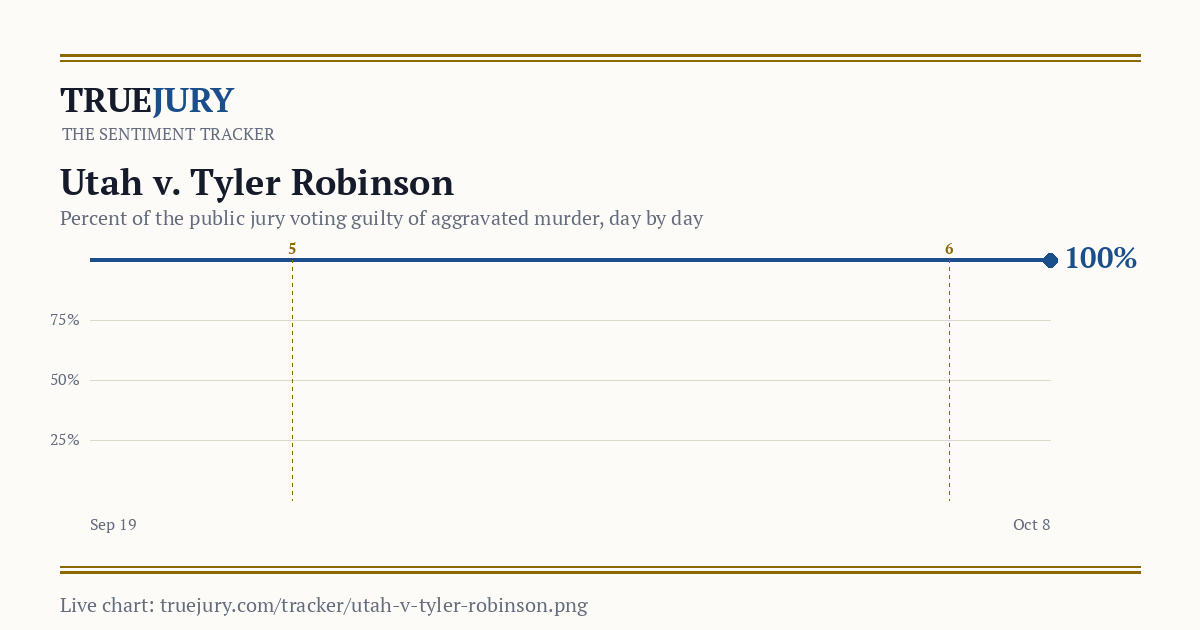
The public jury's standing verdict, day by day, as the trial unfolds. Percent voting guilty of aggravated murder.
Numbered ticks are entries in the Docket Log: what the jury was reacting to.
Newsrooms: this chart lives at truejury.com/tracker/utah-v-tyler-robinson.png and stays current. Cite as The TrueJury Project with the case number; methodology is public.
Your Verdict
Forecast: an assessment of the record and a prediction. The real jury decides the case.
You have read the file. How do you find?
The jury's split is sealed until you vote.
Get the verdict the moment the real jury returns.
One email when this case is decided. Nothing else, ever.
The Deliberation Room · 0 arguments ↓ Share this case
The Deliberation Room
Seated jurors argue the case here, on the record. House rule: argue the evidence, not the person. Every argument is checked against the house rules the moment it is filed and publishes at once; the Clerk audits the record afterward.
Deliberations are for seated jurors. Cast your verdict above to take your seat and join the argument.
The room is quiet. Yours could be the opening argument.
Sources and Coverage
Every TrueJury case file is drawn from the public record. Check our work:
Case verified against the public record before opening. This is a pending case: the file reflects the charging documents and the preliminary hearing as reported, not a trial record, which does not yet exist. Outlet, headline, and date are given so any juror can check the house's work; all links checked live September 2, 2026.
- Wikipedia, "Assassination of Charlie Kirk" (orientation only; retrieved September 2, 2026): background and timeline. Every load-bearing fact in the file is supported by the news sources below.
- NPR, "Judge to decide if Tyler Robinson will go to trial in Charlie Kirk murder case", September 1, 2026: the seven counts, the death penalty notice, closing arguments.
- Deseret News, "What we learned during Tyler Robinson's preliminary hearing", July 10, 2026: the hearing evidence, including the roommate interview and the note and texts as alleged.
- PBS NewsHour, "Lawyers for man charged with killing Charlie Kirk try to sow doubt about DNA evidence", July 10, 2026: the defense challenge to the DNA testimony.
- CNN, "Case against suspect in Charlie Kirk's killing can proceed to trial, judge rules", September 2, 2026: Judge Graf's probable-cause ruling.